The Amp
  • Home
  • Publication
  • Podcasts
  • Featured Playlists
  • About
  • Contact

8am: LéPonds

7/31/2018

0 Comments


BY ANNIE BRYAN

Picture
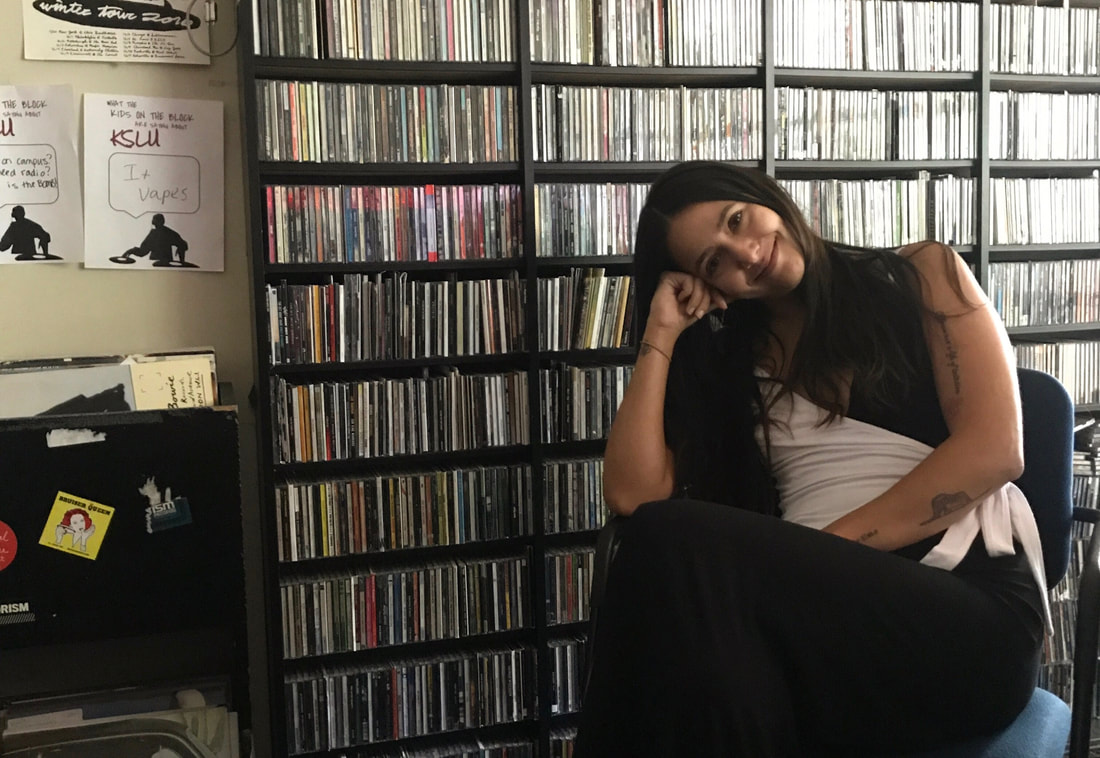
Lisa in the Studio


CLICK HERE TO LISTEN


Here lies a call to action. Get up early and complete rewarding tasks that bask in self forgiveness, universal gratitude, and planetary love. There is a ritual to caring for yourself, your home and your space. We each must find our own actions that branch to an intentionality beyond that of just a “task.” It takes a long time to find the things that make us happy and charge our lives with fullness, and that’s okay. Have a good journey.

At 8 in the morning on Wednesday, July 25th, Lisa Houdei of a gift to the St. Louis music scene, LéPonds, arrived to KSLU for a few hours of amplified wholesomeness. Walking to the studio, she marveled at an unidentifiable native floral plant which had made its home in a bit of grass along our commute. I thought about how many times I had passed the plant, and it’s reiterations across campus, and never questioned its name.

By this time in the morning, she had cared for her sixty house plants, handful of dogs and cats, several chickens, two ducklings, and her garden. Intent on fostering a total haven of sorts in the space behind her home, Lisa does away with any language synonymous to “yard.” On this she quotes her favorite Parisian decorator, saying “if you want a garden have a garden, if you want a yard have a yard.”
​

LéPonds’ sophomore album, I Was Dancing With My Dream Team, slowly made a home in some hearts as it released online on July 21st, 2018. Two years after her premiere album Heat, the cumulative sound of I Was Dancing With My Dream Team builds a family of femininity and playfulness as it grounds us in around the edges of life. From personal manifestos to quirky bits of fiction, the lyrics and the meaning behind how they sound paint a picture: what is it like to be a woman right now? What is a safe level to joke around? We can use her album to question how likely it is to, really, fall in love with a gentleman caller. We can use her album to dive into the confusion of existing right now and of trying to foster some love between the bits of what life is. Sometimes, the bits suck.

​
“Say you wanna fall in on the porch
Red
He was gonna bite I was walking home
Red
Gone for red”*
​

When things get heavy, it’s okay to back out. Knowing when to pack up and leave something behind, no matter how much pain there is, is epitomized in Red. Every way in which we connect with each other runs the risk of growing red- and we live it. It won’t be red forever.


We can learn to take things lightly. The red of something breaking and ending runs sour, but we can use the energy it has to lose ourselves in the imaginary for a little bit, to forgive sexual assault-intrigued men (more on this later), and to actually live a little bit.

The butterfly effect of caring for those around you is a basket of small decisions which build and brace for impact. Maybe each ritual isn’t a permanent decision, but it is one for our own longevity and health. Nothing lasts, but we can make what we have a lot denser with fostering personal and interspecies connection, grounding ourselves, and taking note of the little pieces of the planet around us.

In the end, maybe it’s not about what you fill your time with or what gives you the capital, both social and otherwise, to survive that is most important. Maybe it’s how we fill our little gaps between it all that matters the most for us. Maybe we find ourselves most true when we care for plants, ducklings, or creating a novel or a journal entry into lyrics. That bit is up to you.

Lisa holds an energy that grounds us. Taking notice and appreciation in the tiny gifts of the world, giving back to the world, and being gentle and hopeful along the way. We will all be okay.

Maybe the takeaway from I Was Dancing With My Dream Team is to care for something to care for yourself. Maybe the takeaway is to turn the “this is water” of it all into something lighter. To take the red of something and to recognize how it won’t last forever, as nothing ever ever does.  Maybe we give to ourselves when we pay homage to our local humans in the form of love, and it’s physical manifestation, art. I hope this finds you in a good spot. Go water a plant.
    
​

+

LéPonds
Bandcamp: https://lepondsmusic.bandcamp.com/
Website: https://www.lepondsmusic.com/
Instagram: @leponds

KSLU
Website: kslu.slu.edu
Instagram: @kslu.radio
Author: [email protected]

​*Interpreted wrong, but that's all okay.
0 Comments

Threads of Bad Bad Hats: An Interview

7/16/2018

0 Comments


by annie bryan

Picture
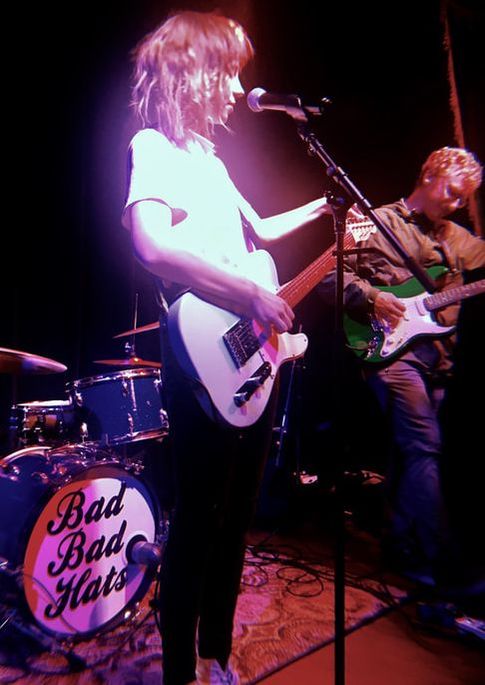
Bad Bad Hats at the Monocle

click to Listen to the interview on soundcloud


​On June 28, 2018, KSLU ally Brenna Sullivan and I interviewed Bad Bad Hat’s Kerry Alexander before their headlining set at the Monocle. As it stormed outside the day of their show, Bad Bad Hats musicians Chris Hoge and Connor Davidson sipped PBR and lounged at the bar as fans filtered in and around them. Kerry Alexander, lead singer and guitarist for the group, wore the same grey t-shirt she wore during their opening set for Coast Modern at the Firebird in February.


Sitting in the plush bay window-adorned corner, I leaned over a coffee table and prayed to the witch goddess above to ensure my phone picked up the notes of Kerry’s casual, prophetic vernacular. With an inflection to battle all else and a sense of humor quintessential to midwestern self-deprecation, Kerry’s message runs clear: turbulence is inescapable. After this conversation, the group resurfaced to an STL stage for the first time in several months after a phenomenal opening set by optimistic, empathetic, and friendly Detroit-founded Shortly.
Picture
Shortly at the Monocle
As their third album, Lightning Round, preps to drop, released singles prelude a sound both vivacious and cumulative of their previous compendium. With singles “Talk With Your Hands” and “Write it on Your Heart,” the artists grabs entre from odes to surf rock like Hazel English, DIIV, and Lush by Snail Mail.

Through their lexicon, Bad Bad Hats has found their thematic loop. With silk-lathered lyrical and indie-pop instrumental sounds a tribute to rock, their discography repeats itself in ways that only become more self-aware as new albums churn out. Lead singer and writer Kerry Alexander’s lyrics metamorphosize an energy of the loss of love before it happens, during its presence, and after it’s been cut.  

In a corner on a rainy Thursday night, we discussed loops.

“Spare me your love
Cause maybe you’re a stranger to me too.”
Write It On Your Heart
​

The threads of this life tangle in painful and manic ways. Somehow, through it all, the strands manage to coagulate a shape we can see only when zoomed out. The knots that rule our lives are loops- tragic ties both disheartening and mundane to detangle and impossible to prevent. Every so often, we have a new knot to untangle, a new end of something. As ritualistic as sunset and painful as truth, end end of a period of your life is knotted, dusted, and chaotic. There is nothing on this world that is capable of evading it’s demise. We can never escape death- a painful thread for Kerry.

Post-show and pre-third album release, perhaps the most quintessential of all of the work of Bad Bad Hats is Spin, the ultimate track from Psychic Reader.

“Now and then I have to stop and count to ten
These thoughts fill me like a dryer, and just spin, and spin, and spin
And I’m afraid to die, but I ignore the reasons why
I cannot wash away this feeling”
-Spin
​
The lyrics of Spin weave a thread of the thought patterns of our greatest fears, or the thoughts that consume is. Spin is about our fear of dying, and the innate fear in all of us of it. In our conversation, Kerry mentions her fear of being forgotten, within itself another death. “I do feel like there is something with art and putting yourself into something physical and tangible for other people is something for other people to hold on to, like immortality,” Kerry said, equating her art to a personal tombstone.

Feedback loops, as aforementioned, girth the lyrics of Bad Bad Hats. The feedback loop of what could happen, what will happen, and what we do to create the loops we hate.
​

“So cut the act and let’s get on with it
'Cause I could, I could run
And be this sad with anyone
Don’t ask where this is coming from”
-Talk With Your Hands  
​

In a corner on a Thursday night, Kerry and I talked about death and chaos a bit more than I intended to. Through it all, turbulence reigns as the thread of the loop of the ride.


What does a pattern feel like? Can you see the cycles from the inside? Does acting against your own just enforce the process again? Do you think the waves into action? We fear and we stress, we act against the stress and create it accidentally. We disengage with something and find it in a separate corner of our lives. We make mistakes, we challenge ourselves, and we live.

There is a lot of connection to be found in Bad Bad Hats. From indie-pop and surf-rock instrumentals to sickening lyrics that knit each of our problems together, we can all find ourselves in Bad Bad Hats. If you’ve experienced internal or external chaos, felt loss, or created something that couldn’t last, there is something for you in their discography.

Notice your loops. Thanks for listening.

​
+
BAD BAD HATS
Instagram: @badbadhats
Website: www.badbadhats.com/
Spotify: open.spotify.com/artist/2bstapBmz…WzS2e00J14xExKCQ


SHORTLY
Instagram: @shortlymi
Bandcamp: https://shortly.bandcamp.com/
Next STL SHOW: www.facebook.com/events/215335849293567/
Spotify: open.spotify.com/artist/45q7ao4hK…m8QpSdtAUF_Oif1g


KSLU
Instagram: @kslu.radio
Facebook: @kslu.slu.edu
Listen: kslu.slu.edu
(turn your phone sideways)

​+
Edited by Brendan Eckert
0 Comments

Caleigh's Corner: The Slaps and Manwolves

7/14/2018

0 Comments


By CALEIGH HORAN

Picture
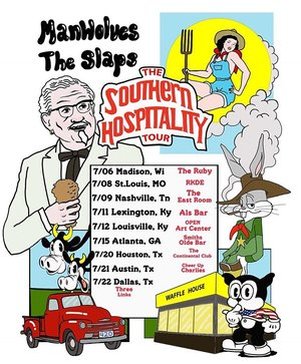
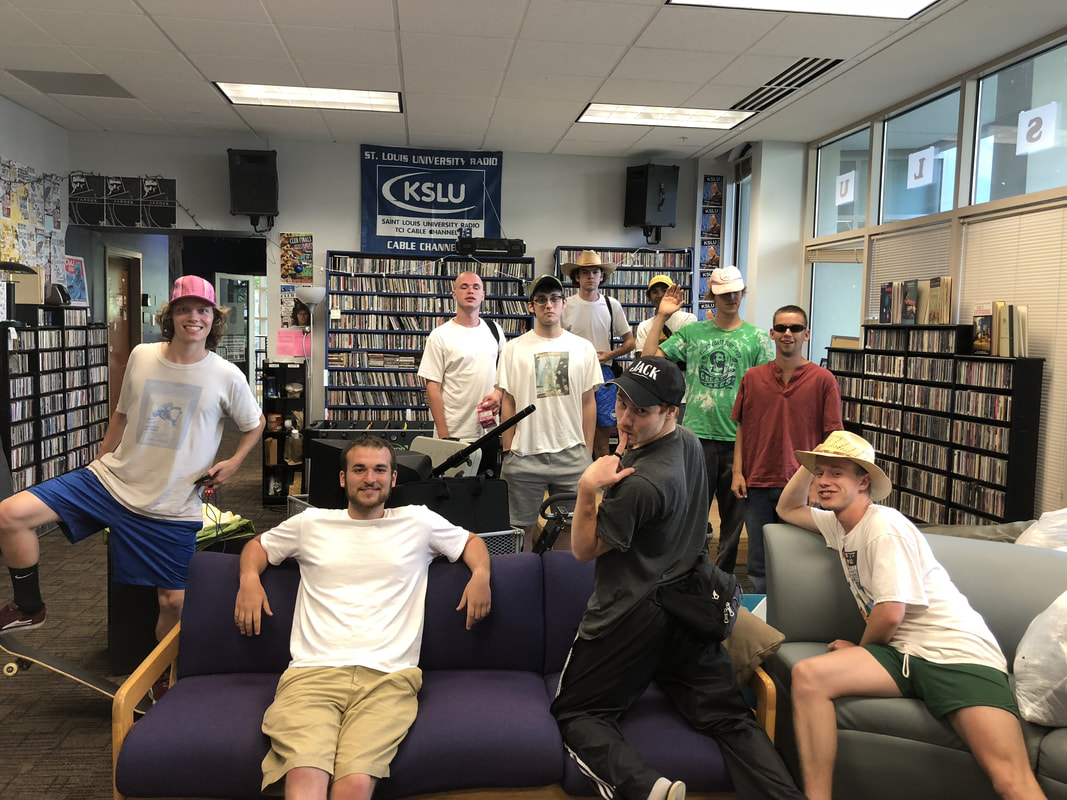
On a sweltering Sunday afternoon in early July, KSLU General Manager Caleigh Horan embarked on her first interview in a series she has deemed Caleigh's Corner. Her first guests in this thrilling saga were The Slaps and Manwolves, two Chicago-based bands that played RKDE on Sunday, July 8th. The St. Louis stop was an early part of a three-week "Southern Hospitality" tour that extends through July 22nd.
​

Click Here TO LISTEN VIA SOUNDCLOUD


​There was much diversity to be found among the groups; The Slaps are heavy in beach-rock guitar while Manwolves incorporate elements of hip-hop into their serving of indie (DON'T call it Ska, though). Fresh off of  6 hour car ride down the always thrilling I-55, the boys were giddy and random, allowing the conversation to transverse from their Wisconsin farming experiences to their latest favorite memes. With wit and sarcasm and charm, these band members filled the KSLU studio with laughs through the entirety of their visit.

Keep an eye out for some exciting new projects post-tour!

XOXO,
KSLU: Saint Louis University College Radio
  
Picture
The Slaps
Instagram: @the.slaps
Contact: [email protected]

Manwolves
Instagram: @manwolvesband
Contact: [email protected]

​Contact KSLU:
instagram @kslu.radio
facebook @kslucollegeradio
general manager [email protected]
0 Comments

AN ACID CATALYZED REACTION

7/10/2018

0 Comments


BY MANISHA WOHLFORD

Levels of familiarity with drug culture may vary widely among the general public of American society, but whether or not one has personal experience with drug usage, many recognize the role that drugs play in American popular culture, particularly within the music realm. Lysergic Acid Dyethylamide has many names -- Lucy, Acid, LSD -- but regardless of the terminology employed; the hallucinogenic drug has become notably intertwined with the music sphere.  LSD belongs to a class of drugs called hallucinogens, mind-altering substances which cause people to experience hallucinations and dissociative effects. A deeper understanding of the development of acid and its effects on users helps illuminate its impact on the music of many artists. Albert Hofmann, a researcher with the Swiss chemical company Sandoz, developed LSD in 1938, and soon after became a symbol for counterculture of the 1960s (“LSD”). LSD ignites a sense of introspective existentialism that drove the cutting-edge sounds found in the popular music scenes of both the 1960s and the 2000s.  LSD has served as a catalyst for some musicians, the effects of acid experienced by these artists inspired many admired sounds, as can be seen through individual songs and testimonials of The Beatles which influenced modern artists like A$AP Rocky.


The benefits from experimenting with psychedelics is evident with The Beatles. This English band invaded the American music scene in 1964. Members of the band credit experimentation with psychedelics for much of their later inspiration and success. The invasion of the wholesome boy band from Liverpool brought lighthearted pop rock tunes such as the chart topping “Eight Days a Week”. The Beatles experimentation with recreational drugs began three years before their "American Invasion” (Gilmore).  The members of the band used stimulants simply for staying awake and fighting to stay relevant in the highly competitive music industry. The Beatles regarded their musical career with sedulous care and were willing to use any means in the pursuit of improving their sound. In 1964, the band members began to dabble with other drugs, such as marijuana, which was introduced to them by Bob Dylan (Gilmore). The Beatles did not intentionally experiment with LSD. Two of the members, George Harrison and John Lennon, ingested the drug unknowingly at a dinner party in 1965. The host, a dentist friend of theirs, slipped the drug into Harrison’s and Lennon’s after party coffee. Although frightened by the unexpected acid trip,  the hallucinogenic qualities of LSD began to encapsulate their beings and the men were permanently moved by their experience. In a sense the Beatles did not find LSD, LSD found them.


After this experience, they were open with the idea of experimenting with more than just their life choices, but also their sound. According to George Harrison, all of the Beatles experimenting with psychedelics was necessary for the group to continue through the '60s.


"John and I had decided that Paul and Ringo had to have acid, because we couldn't relate to them any more. Not just on the one level - we couldn't relate to them on any level because acid had changed us so much. It was such a mammoth experience that it was unexplainable: it was something that had to be experienced because you could spend the rest of your life trying to explain what it made you feel and think." (Gilmore)


In the album that was released the following year, Revolver, the band’s usage of LSD is especially evident in the song  "Eleanor Rigby ” where the change with their sound is clear.


When comparing the changes of the art on the Beatles for Sale album (1964) and Revolver (1966) there are no subtleties. When looking at the album art for  Beatles for Sale; the four faces of Ringo Starr, Paul McCartney, George Harrison, and John Lennon are looking right at you. The album art for Beatles for Sale is a color picture of the four band members outside, this is just a basic picture of the band. They are outside and wearing black coats showing how they are just like any other human that is not beyond wearing a coat in cold weather. This expresses how the band was about the simple sound of pop rock; the album art made them more commonplace.


The album art of Revolver is surreal and strange accompanied by the stark use of black and white. Revolver’s large, stylized illustrations of the each of the band member’s faces are accompanied by smaller real photographs from their tours. The stylized illustration of their faces showcase how LSD has aided in the transcending from their successful ,albeit, unimaginative past; the past that is represented by the real photographic pictures of them on the album art. Proof their creativity was expanded by the use of LSD.


The lyrical style changes between these two albums are evident in “Eight Days a Week” from Beatles for Sale and “Eleanor Rigby ” from Revolver. “Eight Days a Week” starts with an upbeat guitar riff. The song is unblurred with the straight forward lyrics:


Ooh I need your love babe
Guess you know it's true.
Hope you need my love babe,
Just like I need you.
Hold me, love me, hold me, love me.
Ain't got nothin' but love babe.


It is a song written about one’s adoration for their lover and there is not a lot of room for misinterpretation. The song relies heavily on repetition showcasing a lack of depth and highlighting simplicity.


The song “Eleanor Rigby” features a variety of string instruments ranging from violas to the cello and included a complete absence of the previously relied upon guitar that the band was well known for. The song’s hauntingly hypnotic harmonies, lead to feelings of a dream like state; which strongly mirror the mental state of an LSD trip. The opening stanza is :


Eleanor Rigby, picks up the rice
In the church where a wedding has been
Lives in a dream
Waits at the window, wearing the face
That she keeps in a jar by the door
Who is it for


These lyrics introduces themes of loneliness and eventually death alone which were themes not seen previously or touched upon in their previous work -- the Beatles were no longer making light hearted love songs. “Eleanor Rigby” portrays  more creativity and depth while dealing with a topic of that is the antithesis to “Eight Days a Week”. LSD opened them up to the realities of a more nuanced world through their gained introspective existentialism.    


According to many accounts, during the time the album Sgt. Pepper’s Lonely Hearts Club Band was in recording sessions,  Lennon was using LSD so frequently he began experiencing symptoms of ego-death (Gilmore). Ego death is a side effect of prolonged exposure to LSD that results in the idea that one has lost the subjective self-identity (Nour).  This effect was ever present, evident in the fact that Lennon felt he was disappearing within the band and himself, as well as, proclaiming he was Jesus Christ returned back to Earth (Gilmore). Although Lennon experienced the negative aspects of LSD it was the price he was willing to pay for the unimaginable success their music post drugs achieved. Sgt. Pepper’s Lonely Hearts Club Band even contains their ultimate tribute to their love of LSD in the song "Lucy in the Sky With Diamonds." The title of this song abbreviates to LSD; thus proving that they believed acid played a pivotal role in their success and creativity. The Beatles went from being a poppy boy-band to enlightened pioneers reinventing the popular music scene with drugs aiding the alteration of their sound.


The impact The Beatles made on the music industry resonates with musicians such as A$AP Rocky, a rapper that claims that psychedelic drugs play a role in his creativity (Macbain). His song “L$D” proclaims his admiration for LSD and in the lyrics explores the profound effects the drug.  Not only does he share a love for the psychedelic drug but he also has a public admiration for The Beatles. In an interview with Evening Standard Magazine he said,  “It is so inspirational to go against the grain. The Beatles were at the top of their game doing all that pop shit. And then they do some leftfield shit -- and it worked. Those guys are geniuses”(Macbain). He took this countering behavior and applied to his own philosophy on making music “ I’d be confused if I tried to fit in. I’m an innovator (Macbain).” A$AP Rocky further validates the influence The Beatles have on him by his use of the more modern sounds of synthesized instrumentation in “L$D” that mimics the hypnotic harmonies exhibited in the song “Eleanor Rigby”.
​


LSD has served as a catalyst for some musicians, the effects of acid experienced by these artists inspired many admired sounds, as can be seen through individual songs and testimonials of The Beatles which influenced modern artists like A$AP Rocky. LSD changed the way The Beatles perceived and interacted with their musical realm. The Beatles innovated their sound and the lyrical themes they used in their music by using LSD. Without this psychedelic would The Beatles have ended their career as a group of boys bopping around about their next love affair? Lacking the movements made by the Beatles permanently altering the music industry of their time, there would be no lasting effects causing changes into the modern era.  LSD has accelerated the growth and development of many artists allowing them to reach towards their own achievements. This lasting impression is looked upon with the reverence as A$AP Rocky has learned from their philosophy and use of LSD as he has applied it to his life. LSD has informed these musicians’ world view. Without this psychedelic substance, the pivotal changes would not have occurred and modern music as we know it would be a significantly more shallow affair.

REFERENCES
​

Berry, et al. Rock and Roll Music ;Eight Days a Week.


Gilmore, Mikal. “Beatles' Acid Test: How LSD Opened the Door to 'Revolver'.” Rolling Stone, Rolling Stone, 25 Aug. 2016,


History.com Staff. “LSD.” History.com, A&E Television Networks, 2017.


Lennon, and McCartney. Eleanor Rigby ;Yellow Submarine.


Macbain, Hamish. “Why A$AP Rocky Is Music's Most Exciting Star.” Evening Standard, 28 Sept. 2017.
​


Nour, Matthew M., et al. “Ego-Dissolution and Psychedelics: Validation of the Ego-Dissolution Inventory (EDI).” Frontiers in Human Neuroscience, vol. 10, 2016, doi:10.3389/fnhum.2016.00269.

0 Comments

Dapper Dan: the Face of Modern Gucci

7/10/2018

0 Comments


BY MANISHA WOHLFORD

“Gucci gang, Gucci gang, Gucci gang, Gucci gang, Gucci gang, Gucci gang, Gucci gang, Spend three racks on a new chain” (Lil Pump). Thus begins “Gucci Gang,” an arguably catchy song by rapper Lil Pump that went platinum early in 2018. With a refrain that mentions the Italian clothing brand, Gucci, upwards of twenty times, it is hard to miss the significance of its repetition: Society finds Gucci to be incredibly desirable. “Gucci Gang” is a recent, prominent example, but the brand itself is not actually a new face in the hip-hop circuit. Gucci has been referenced in the hip-hop circuit by various rappers, from 2Chainz to Pusha T, as a means of suggesting wealth without necessarily speaking directly about the amount of money they make. This lyrical materialism represents a triumph over poverty and an extreme compensation for their disadvantaged past. Deemed a point of success in hip-hop, Migos uses high-fashion references in the song “Bad and Boujee” to assert their dominance: “Boy, you so fake, like my collar you snakin' I swear to God that be that Gucci” (Migos). With all the exposure and publicity that dominant fashion houses get, hip-hop is changing the world of high fashion, a phenomenon that can be seen with Gucci, the most mentioned brand in hip-hop (Gayomali). There is an interplay between the world of high fashion and hip-hop, a sample of which can be seen when examining Gucci”s homage to the famous hip-hop fashion designer, Dapper Dan.
Daniel Day, more popularly known as Dapper Dan, was an architect of pop culture fashion design in the 1980s. He made clothing for basketball players and rappers. Born and raised in Harlem, the focus of vibrant black culture, Day knew that “fashion and culture were on different sides of the same coin” (Cooper). The subculture in Harlem provided a substantial amount of money in the street. This allowed Day to open up a store with the clientele from this subculture (“A$AP Ferg Interviews”).  
Materialism is a common theme in hip-hop lyrics with clothes reflecting social status. The need to dress to impress is part of a generational mindset for many black men who grew up in Harlem (Cooper). One day, someone came into Dapper Dan’s boutique with a Louis Vuitton pouch, and everyone went nuts. This simple pouch is where Dapper Dan’s idea began. The logos on the bag were just symbolism. If one was happy with a small pouch ordinated with the logos, imagine what would happen if they could have a whole outfit. In regards to the topic, Dapper Dan said, “the label is the thing the gangster clientele use to let the other gangsters in the street know, ‘You ain’t got what I got.’ It’s the label that set you apart,” (Cooper). At the time these dominant fashion houses were not making clothes in Dapper Dan’s style (Schneier).  Dapper Dan was avant-garde with every stitch he made.
​

Counterfeiting brands was necessary to assert dominance, and with every forged logo, he made clothes decorated with emblems of dominant fashion houses. The pieces with the fraudulent logos elevated the clothing to levels of fine art (Schneier). Day’s motivation to create these counterfeit creations comes from childhood woes where he was “always denied new clothes,” and hoped for a future where he could “wear suits and ties,” reinforcing the purpose of brand-referencing in rap and hip-hop (“A$AP Ferg Interviews”). It is a sign that one has accomplished all that they can, given their circumstances.

Dan, like any exceptional hip-hop star, was sampling- a common practice in music. Instead of borrowing beats, he was borrowing logos. Dapper Dan gained hype as many hip-hop artists flooded to him because they could not initially afford to purchase Gucci items. This phenomenon is interesting because in a way, Dan was sampling as many hip-hop artists do. Some of Dapper Dan’s most notable creations were for hip-hop artists, Rakim and Eric B. He made them flashy track jackets decorated with Gucci’s monogram.  He also designed garments with fraudulent logos for LL Cool J, Salt-N-Peppa, and Run DMC, all of which were famous names in hip-hop. However, the brands Dapper imitated, such as Gucci and Louis Vuitton, shut his ten-year operation down using legal actions in 1992 (Schneier).

Gucci, the Italian brand famously known for their interlocking GG monogram, began in 1920 and quickly rose to the top of the world of high fashion. With many changes in leadership, Gucci has managed to stay relevant consistently (Gayomali). The current creative director is Alessandro Michele, and he has taken a new approach towards the whole appearance of Gucci, which was previously known for an expensive, polished look. The new designs feature many hip-hop influences. Alessandro Michele’s efforts have resulted in songs named after him, as well as recognition in “RAF,” another chart-topping song (Gayomali). Michele introduced a decorated all-white sneaker into the collection, a spin on a staple of hip-hop style. The influence hip-hop has on the current state of Gucci does not end here.

Fashion trends tend to recycle every so often, and this typically occurs seamlessly. Luxury brands were doing so without issue until conflict rose in 2017, when a design that Dapper Dan came up with at the height of his career was “borrowed” by Gucci. In 1989, Dapper Dan created a mink jacket with puffed sleeves decorated with the iconic Louis Vuitton logo for Olympian Diane Dixon. For Gucci’s 2018 Cruise Collection, which made its debut in May of 2017, almost 28 years later after Dapper Dan’s design, Alessandro Michele sent an almost identical jacket out on the runway, the only difference being the Gucci logo in place of the impostor Louis Vuitton markings on the original Dapper Dan design (Schneier). Although not initially considered a trend in high fashion, Alessandro Michele found Dapper Dan's legacy relevant enough to include in his line.

This particular incident illuminates an issue in fashion and hip hop’s exchange. The line between appropriation and homage is fragile in this case. Did Alessandro Michele rip off Dapper Dan? Is this cultural appropriation? Vice magazine accused Gucci of “ruining culture,” but Gucci quickly said that the piece was a tribute, not appropriation (Schneier). Cultural misappropriation is the act of taking or using things from a culture that is not one’s own, especially without showing that they understand or respect this culture. Appreciating another culture is a cultural exchange. One would have to consent to participate in some culture, and both sides mutually benefit and gain an understanding of each other.  On the other hand, appropriating another culture entails taking from a marginalized group without permission, usually with little respect for or knowledge about the culture.

The efforts Dapper Dan made are an integral part of Gucci’s history. Dapper Dan first copied Gucci, and then Gucci copied Dapper Dan (Cooper). Michele defends his decision by saying, “We are recognizing the power of this work. The message for me is that we have, in a way, recognized a huge piece of the history of the brand. It is the time to say that fashion is not just the windows of a Fifth Avenue store. It’s more. It’s about culture,” (Schneier). Dan was not offended by Michele’s decision, he was “excited about it being there” and recognizes that he comes from a different world than the designer. He says that “the magic that took place was a result of what he did by bringing these two parallel universes together,” (“A$AP Ferg Interviews”). Alessandro’s action opened a dialogue between the two artists. Through conversation they were able to see similarities in their life experiences and the way they grew up. Dan was able to see how Michele was influenced by his work in the 1980s, and he was “never apprehensive about what took place” (“A$AP Ferg Interviews”).

Dapper Dan has become part of the canonicity -- he was absorbed into the culture. Michele’s decision was not appropriation; he paid tribute to an inventive artist who paved the way for self-expression not previously seen in high fashion. The jacket was unmistakably under Dan’s influence and recognized on the catwalk regardless of captioning the piece (Schneier). Dapper Dan is much like any other artist in history.

The actions of Gucci in May 2017 bring aspects of luxury, class, and race into question. ASAP Ferg, the son of a man that worked for Dan, says how the work Dan did “taught them how to use their designs in a much more effective way. Dan curated hip hop culture”  (“A$AP Ferg Interviews”). Not only did Dan open a door of expressivity, “he actually taught an entire generation how to engage with luxury brands,” as pointed out by Steve Stoute, a prominent face in fashion. He furthers this claim by saying “ Luxury brands, at that point, were not for us. They didn’t even have sizing for black people. So every time I walk into Louis Vuitton to buy a pair of sneakers or buy a pair of pants in my size, I know they’re only doing it because of Dapper Dan” (Cooper).

The current state of Gucci shows a respectful exchange of culture. Michele is just sampling in the way that Dapper Dan once did. The iconic jacket sent down the runway was only a reference, or symbol, that honored the history of Gucci. The fashion industry is indebted to Dapper Dan, and the credit Alessandro Michele paid to Dapper Dan was necessary.  Dapper Dan was calling on Gucci's authority, and what Gucci has done is leverage on his influence. Gucci is now wearing Dan, and it is his status that is finding relevance in this hip-hop-steeped environment of the 21st century. Gucci is an image in hip-hop, and this is an interplay of artistic creation. Gucci is now wearing hip hop.

REFERENCES
​

“A$AP Ferg Interviews Dapper Dan, A Harlem Legend & Fashion Icon.” YouTube, MTV News,    16 Aug. 2017, youtu.be/OgiAmluJDP0.


Cooper, Barry Michael. “The Fashion Outlaw Dapper Dan.” The New York Times, The New York Times, 3 June 2017, www.nytimes.com/2017/06/03/fashion/dapper-dan-harlem-gucci.html.

Gayomali, Chris. “Most Popular Fashion Designers Based on Rap Song Mentions.” GQ, GQ, 17 July 2015, www.gq.com/story/statistical-analysis-of-rap-and-fashion-designers.


Lil Pump. “Gucci Gang.” Gucci Gang, 31 Aug. 2017.


Migos . Culture, 28 Oct. 2016.
​


Schneier, Matthew. “Thanks, Internet Outrage! Now Dapper Dan and Gucci Are Buds.” The New York Times, The New York Times, 10 Sept. 2017, www.nytimes.com/2017/09/10/fashion/dapper-dan-gucci-partnership.html.

0 Comments

Pink Floyd ANALYSIS

7/10/2018

0 Comments


BY MANISHA WOHLFORD


In 1996, almost thirty years after their formation, Pink Floyd was inducted into the Rock and Roll Hall of Fame (O’Brien, 2018). The band is very creative, and this avant-garde creativity, although unique, poses societal issues. Through their unconventional use of technology and visuals, political messages represented during performances, and their characterization of women in their work, Pink Floyd has had a vast and complex impact on popular music culture. From the beginning of their stage career, they have been enhancing their performance beyond pure musicianship, further sharing their artistic vision with the use of elaborate stage production. Pink Floyd’s use of technology and visuals, in particular, allowed the band to be known not only as musicians but also as audio-visual artists, helping them avoid the monotony that often occurs when bands perform for large audiences. The shows were very elaborate, and they got more intense and deep as the shows continued. The props used in the production of their shows included blimp-like balloons, notably a pig balloon, and these balloons were at the forefront for political statements posed by the band. After Roger Waters, the bassist, separated from the group, he continued to use the floating pig to provide further commentary on political issues affecting the world in his solo shows. This usage has gotten him into trouble -- Although Waters used the pig to promote many political messages and initiate conversations among members of society, some of his themes raised strong controversy and backlash, mainly his usage of the Star of David on one of the pigs. Pink Floyd’s controversial messages were not limited to live performances. The depiction of women in the rock music scene, a scene primarily dominated by men, is problematic, and with all of the fame Pink Floyd was granted in the rock world, their adverse representation of the female mother in the 1982 film Pink Floyd: The Wall exemplified the misogynistic symbolism plaguing the genre. It is through these three lenses that some of the impact Pink Floyd has had on the popular music scene can be understood.


​essay 1: beyond the music


When placed in an arena, a band's creativity can often become lost in the monotony of what occurs when needing to project a song to an audience of more than 15,000 people (Ethen, 2014). With larger shows, musicians run the risk of losing their individuality and falling into the category of arena rock, ousting their creativity. To stay relevant in pop culture and help avoid losing creativity in front of larger audiences, Pink Floyd employed other aspects of art culture aside from their music itself. Pink Floyd’s use of technology and visuals, in particular, allowed the band to be known not only as musicians but also as audio-visual artists. 

Pink Floyd elevated  the live music experience, renowned for their costly stage shows that combine intense visual experiences with music to create a show that takes emphasis away from the performer and highlights other performance elements. Pink Floyd's combination of music, visuals, and innovative use of sound effects and panning quadraphonic speaker systems set the standard for rock musicians (Calore, 2009). When in an arena setting, enhanced audio and visual technologies were used in efforts to increase the band’s presence during concerts (Ethen, 2014). Pink Floyd used elaborate props and stage contraptions to accentuate rock theatricality, to highlight the psychological dimension of their lyrics, and to serve as a platform onto which audiences could project their desires and anxieties. 

One aspect of performance enhancement was the light show that Pink Floyd used. In the beginning, they used a slide-and-light show, as well as original light shows, complete with abstract films and bubbling. In the very beginning, the band incorporated a traveling light show. Dynamic liquid light shows were projected onto enormous screens behind the band while they played. When using a strobe light, the members of the group would disappear and reappear, which added an obscure visual element to the show. On May 12, 1967, Pink Floyd performed a surround sound concert at “Games for May” at London’s Queen Elizabeth Hall, this was the first performance of its time. This concert experience raised the standard of what audiences would come to expect from a live rock performance. "I think Games for May was one of the most significant shows we ever performed," he said. The Azimuth Coordinator, essentially a joystick,  was a unique device for controlling the way of sound distribution among all the speakers in the four speaker quadraphonic ring (Calore, 2009). The noise from the instruments, or even recordings of sounds, could be moved to different corners of the concert hall. The set-up could make it sound like footsteps were moving side-to-side (Calore, 2009). 

After this concert, the artistic standard for their performance would increase even further. The appearance of a large circular projection panel came with performances of Dark Side of the Moon in 1974 and stayed as part of the typical Pink Floyd concert. It was a backdrop for the band's performance and allowed the ensemble to control the panoramic visual experience (Povey & Russel, 1998). In 1973's tour to promote The Dark Side of the Moon, a large-scale model plane soared above the audience's heads and crashed onstage. This unique effect added an element of surprise and wonder to the concert experience. The band repeated this effect at the start of The Wall and the Division Bell shows (Povey & Russel, 1998). Exploding planes are only one aspect of floating props used. Also included as part of the visual experience, large balloons floated above the stage and often represented characters central to the album in use. For example, the trademark giant pig was brought in for Animals in 1977 (Povey & Russel, 1998), and in some shows, an envelope of propane gas was put inside the pig, causing it to explode. During The Wall shows, the inflatables reached their peak.  Characters from the album were brought to life in the form of giant, fully-mobile string puppets with threatening spotlights for eyes, taking the traditional use of balloons to a new level (Povey & Russel, 1998). Balloon usage allowed the characters to become real in the form of physical, artistic expression; their existence went beyond the lyrical interpretation. 

The Wall tour not only employed the use of balloons but also managed to build a physical wall between the band and the audience out of 340 white bricks. For the second half of the show, the performers were mostly invisible except for a hole in the wall that allowed the audience a view.  The primary means of artistic expression were animations projected onto the white wall. The wall was destroyed at the end of the show amidst sound effects and a spectacular light show, a phenomenally elaborate visual spectacle that left the competition far behind. John Rockwell for the New York Times wrote in 1980 that “no band has better solved the problem of how to make a large-scale arena rock show visually distinctive” (Ethen, 2014).

ESSAY 2: THE STAR NOT MEANT TO SOAR
​

A gigantic, pink pig riddled with various statements has floated above many Pink Floyd concerts since 1977 when the album Animals was released (Gilmore, 2007). The pig has been used as a symbol by the band, with each statement invoking thought about the current state of the nation. After Roger Waters departed Pink Floyd, he continued to use the pig as a show element during his solo live performances, fighting to gain the rights to the pig (Gilmore, 2007). When David Gilmour took control after Waters’ departure, he appropriated the pig, Waters' most famous prop, and attached testicles to it, which some read as a commentary on how he viewed the band's former bassist (Gilmore, 2007). The pig was also used to spread a variety of political messages, although Waters states that the pig represents evil, more specifically the evil of the delinquent government (Cubarrubia, 2013). Although Waters used the pig to promote many political messages and initiate conversations among members of society, some of his messages raised strong controversy and backlash, notably his usage of the Star of David on one of the pigs. 

During Summerfest in 2006, the words “Impeach Bush Now” were written on a pig entering the Hollywood Bowl where it was released into the Los Angeles sky during Waters’ show.  Other slogans decorating the pig during this performance included "Kafka Rules OK!" on its side and "Free at Last" written on its underbelly (Glancey, 2017). Waters inclusion of President Bush indicated that Waters believes Bush is responsible for the problems afflicting the United States. The nod to Kafka highlights the antimilitaristic views of Waters. After the show, authorities informed Waters that he would face charges if it were attempted again (Glancey, 2017). Rogers managed to get away with the use of the pig, but it did raise concerns with officials. Even though he was threatened by the police to stop using the massive balloon, he would go on to stir up more issues in following years. 

In 2013 at a performance in Belgium, Waters released the pig that has gathered the most commentary, decorated with the Star of David (Cubarrubia, 2013). Over the years, the flying pig has become a staple of Waters’ shows, serving as a symbol of greed and oppression. Waters has not kept his thoughts about the Palestinian and Israeli crisis to himself, but even though he does not agree with the policies of the Israeli government, the usage of the Star of David was considered inappropriate by many. The Star of David is a symbol of the Jewish people as a whole, not of Israel or its government. The use of the star on the flying pig was blatantly Anti-Semitic.

The Star of David is a symbol integral to Jewish national identity and religion (Goldmeier, 2016). Medieval European anti-Semites made Jews wear Jewish symbols on their outer clothing, and German and Austrian Nazis in the 1930s required all Jews to wear the Star of David on their outer clothing (Goldmeier, 2016). It was a "mark of Cain," a degrading symbol, asserting that the Jews were not Aryans. The star has since become a symbol of triumph and strength (Goldmeier, 2016).

After receiving criticism for the inappropriate and offensive usage of this symbol, Waters sticks by his statement, countering objections by explaining how his father died fighting for Britain in World War II and that his knowledge of the war means that his action was not of Anti-Semitic origin (Cubarrubia, 2013). He furthers his claim by saying he has Jewish friends. Although he has Jewish friends, he is not Jewish, so this is an invalid argument (Cubarrubia, 2013). Waters went as far as to compare Israeli policy to Nazi genocide. Although he claims that the action was not Anti-Semitic, his use of the image is offensive to Jewish people, since he is not of their religion or race, so he cannot entirely understand their critiques on the matter. Given the context and the history of the Star of David, it was insensitive for Roger Waters to use the symbol. He has inappropriately attached the wrong connotations to the Star of David and has ended up violating the integrity of the Jewish population. By using this symbol in this sense, he is turning a blind eye to the oppression Jewish people experienced in the 1930s. Although the purpose of the pig is to stir the pot and pose a dramatic criticism about the current political sphere of the world, Waters directed criticism inappropriately, crossing the line with his use of the six-pointed star, the Star of David.
   

essay 3: THE MOTHER NOT EVEN A CHILD COULD LOVE


​Arguably the most misogynistic and aggressive form of popular music listened to throughout the year, the depictions of women and female roles have been determined largely by men within the rock music genre (Harding & Nett, 1984). The rock music scene is dominated by men, even referred to as “the frenzied celebration of masculine potency,” but the genre itself is broadcast to and widely consumed by the entire population, rendering the lack of women involved in the actual production and performance alarming (Harding & Nett, 1984). The images of women represented within rock music are tailored to the desires and fantasies of men, perpetuating the objectification of women throughout the years (Harding & Nett, 1984). In rock music, a woman is often cast as “good” or “bad” depending on its serviceability for the man making the judgment -- a tool used for a means -- and as the image is judged, so is the woman incarnating that image (Harding & Nett, 1984). An example of this misogynistic symbolism can be seen in the short film created by Pink Floyd, Pink Floyd: The Wall [1982]. 

Pink Floyd is one of rock music’s biggest acts, and the album which the film the was based upon topped the US charts for 15 weeks (Wadell, 2014), demonstrating the broad consumption of rock music by US popular culture, both men and women. The film features the music from the album The Wall (1979) and is supposed to be a reflection of band member Roger Water’s life, following the life of a drugged-out rock star (Waddell, 20114). The symbolic wall this rock star built is a result of his lonely upbringing -- a combination of his father’s death during war and his mother’s absence following that period. Women are typically portrayed as the perfect mother -- nurturing -- or the ideal playmate -- erotic (Harding & Nett, 1984). Just as the image of the nurturing mother could be used to symbolize a form of feminine perfection, portraying a mother as less than nurturing could be used for the opposite characterization. Through the use of flashbacks, it is evident that Pink attributes most of his decline to his mother, casting her in an extremely negative light. 

The film follows Pink after his father died in service to his country in a war, and in the scene showing the death of his father, there are flashes to his mother. The film depicts her as wholly absent, apathetic, and unfeeling to the situation while Pink’s father fights and dies in the war. The film does not attempt to look at the condition of the mother through the lens of the pains of being a single mother and the demons she might be struggling with isolated on her own. Instead, depicted as overweight and napping in the garden Pink's mother ignores her infant child, Pink, crying in his bassinet next to her. She is portrayed as a “bad” mother through this imagery, and the father is cast a victim because he died to protect the life of a selfish woman who cannot meet the needs of her child. In one flashback scene, Pink is shown trying to rescue a rat from the garden, but his mother, again portrayed as a “bad” woman for not being nurturing, makes Pink release the animal back into the wilderness, where it dies. The film creators chose to include the death of the animal to symbolize the mother’s flaws and lack of love and support, mirroring Pink’s sense of isolation from humanity. Thus, the reason for the wall is rooted in the lack of nurturing from his mother. The film is riddled with misogyny, using a male-derived caricature of the “bad” mother which prevents women from being expressed authentically. The mother is situated as the stimulus behind fascism as Pink daydreams about glory in becoming a murderous, Fascist, Neo-nazi leader who kills homosexual men and other minority groups. Through characterizing his mother as careless and un-nurturing, he places her as the catalyst for these thoughts and a more substantial evil present in society. 

This film depicts women as the root of all evil, showing Pink turn into a Fascist leader. The movie uses women as catalysts for Pink’s decadent behavior and drug usage. His mother was controlling and absent, beginning his alienation, and Pink is a victim of his situation (Wadell, 2014). The production uses the reversal of one of the typical portrayals of ideal women in rock music suggested by Harding & Nett, 1984 -- the nurturing mother -- to indicate that females are to blame for Pink’s evil inclinations. 


​references

Calore, M. (2017, June 04). May 12, 1967: Pink Floyd Astounds With 'Sound in the Round'. Retrieved from https://www.wired.com/2009/05/dayintech-0512/

Cubarrubia, R. (2013, August 02). Roger Waters Addresses Star of David Controversy. Retrieved from https://www.rollingstone.com/music/news/roger-waters-addresses-star-of-david-controversy-20130802

Ethen, M. (2014). Arena rock. Oxford Music Online. doi:10.1093/gmo/9781561592630.article.a2261991

Glancey, J. (2017, May 11). The Floating Pig That Became a Sign of Protest. Retrieved from http://www.bbc.com/culture/story/20170508-how-the-pink-floyd-pig-was-a-sign-of-protest

Harding, D., & Nett, E. (1984, Fall). Women and Rock Music. Atlantis, 10(1), 60-76.

O'Brien, L. M. (2018, April 26). Pink Floyd. Retrieved from https://www.britannica.com/topic/Pink-Floyd

Povey, G., & Russell, I. (1998). Pink Floyd, In the Flesh: The Complete Performance History. St. Martin's Griffin.
​

Wadell, R. (2014, November 28). 'The Wall' Turns 35: Roger Waters Revisits Pink Floyd's Enduring Rock Opus. Retrieved from https://www.billboard.com/articles/news/6334573/the-wall-turns-35-roger-waters-revisits-pink-floyds-enduring-rock-opus

​​
0 Comments

LIVE CONCERT REVIEW: BIG TOBACCO

7/10/2018

0 Comments


BY MANISHA WOHLFORD

ASTD 3930-01 / MUSC 3930-01
Instructor: Alan Blair
Live Music Analysis
3 May 2018


​“Up last we have a song that is near and dear to our hearts… we finished writing it about three hours ago. We can actually only play it if we have a capo… but we forgot to bring one with us, so does anyone one in Little Cowboy or Dear Genre have one we can borrow right now?” A man dressed in dark jeans and a flannel reaches into his back pocket and extends a capo from the audience to the lead singer of Big Tobacco standing on stage. Big Tobacco can close the three boy-band show with a guitar heavy, impassioned anti-love song with plenty of jumps and headbanging. Throughout the night, each band had the opportunity to fill the venue with their rock-based sounds. They each came with about ten friends or followers leading to an audience of 30 smiling faces, only filling a fourth of the Ready Room. Three small, local bands coming together to host a concert provides an opportunity for the members to get practice in a live setting which also provides a means for publicity. They were able to connect to fellow musicians that make the same style music as they do.  The use of a small, intimate venue, distribution of CDs, and overall fan connection made for an impactful evening.

By having a small, intimate audience, the bands were able to practice their showmanship in a judgment-free zone. The performers moved through their sets without a second thought about their actions and were able to familiarize themselves with performing in front of a small crowd of people. The main guitarist for Big Tobacco closed his eyes and swayed with emotion as he strummed violently on his guitar and nearly fell off the raised stage when he tripped on the cord plugged into the amp a few feet behind him. Each band had their technical flaws, whether it was the way Little Cowboy could not balance their instruments correctly with the guys working the soundboard; or the amplifier and guitar problems afflicting the guitarist of  Big Tobacco. Not long after the start of Dear Genre’s set, the drummer lost control of his sticks, and they propelled towards the audience. The bumps in performances continued to make the evening feel like a jam session rather than an actual concert. Every hiccup accentuated how the show did not entirely go as planned. Each band adapted to the stage by the end of their sets, and they were able to learn how to perform in front of a live audience successfully. Although the performances had their mistakes, the audience was able to see the band grow before their eyes, enforcing the closeness of the crowd.

Off to the side, a white plastic collapsible table rested with a few t-shirts and posters decorated with Big Tobacco, Dear Genre, and Little Cowboy's names. In addition to the merchandise, the bands had stacks of CDs, each containing a single song. The groups gave these homemade CDs out for free, and it was a way for them to get their music out and have their exposure go beyond their 45-minute sets. This opportunity gives them a means of diffusion for their music, one that is placing a physical copy in the listener’s hand;  more direct than just telling the audience to check their music out on Bandcamp or Spotify. The homemade way of the CDs only made the bands more personable and easy to connect with strengthening their bond with the audience and emphasizing the intimacy of the evening.

Every person in attendance fed off the passion exhibited by the performers and did their best to match that passion through dance and cheering. The bands played at the energy level of the listeners standing only a few feet away, careful to make eye contact while singing, and never failed to engage in conversation in between songs.  The bands used each other's networks of fans and followers to broaden their scopes. All three groups are “underground,” indie bands, so it a sense they were each other's “support” bands. It allowed for greater exposure sustaining a bigger audience, which will probably already like their music based off their attendance to the concert to see the “main act,” in this case, the one band they came to support. The small following of people each band brought with them grew to like the music of the other groups. With their phones tucked away,  the audience was living in the moment, securing the connection between the artists and the newfound fans. Further strengthening this connection, the artists took pictures and conversed with fans after their sets. The intimacy of the concert contributed to the success of the evening, as well as setting the stage for the bands’ future success with their new fan base and mastery of stage performance.
​

Link: ​Big Tobacco
Instagram: @bigasstobacco
0 Comments

UNEXPECTED LOVE WITH LOW CUT CONNIE

7/10/2018

0 Comments


BY ASHLEIGH MONTGOMERY

Have you ever fallen in love with a band at the most unexpected of moments? Well, that happened to me last night. My cousin texted me saying she had an extra ticket to see Social Distortion and I agreed to go, mostly to say I’ve seen Social Distortion live. If I’m being honest, I only knew their one song from Guitar Hero that I always thought was way too long and way too boring. Eager to get out of my house, I went.

I went into this show not really expecting to enjoy or get anything out of it at all. However, I was quickly proven wrong. The first opener for the band, Aaron Lee Tasjan, was fairly entertaining and had a sound reminiscent of 70’s rock, something my dad would listen to. They were definitely super cool, but they were not the band who stole my heart.

The second openers, Low Cut Connie, had my full attention before they even came on. When the stage crew rolled a piano onto the center of the stage, I was instantly intrigued, as piano is not something you rarely (more like never) see in the punk scene. As the band entered, I first see the well-dressed drummer, a tambourine player/back up singer, and a guitarist dressed exactly like Hyde from That 70’s Show. Then entered the bassist smiling ear to ear and a second guitarist with the coolest rockabilly/greaser style. Already, this band was the most eclectic group of people I’ve ever seen on stage together, and I was just awaiting the arrival of the pianist.

After the band jammed out for a minute or two, I see a man, who had a very Freddie Mercury-esque vibe, running rather energetically onto the stage. This was only the beginning to probably the most theatrical performance I’ve ever seen. He climbs atop his piano and kicked his leg disturbingly (but also impressively) high and began to hype the crowd up. He continued to do so throughout their set, whether it was by standing on his piano shaking his butt, grossly mispronouncing Sauget, or pretending to rip his chest hairs out, there was never a moment where the crowd was bored.  

While the lead singer/pianist was entertaining, the rest of the band was hard to ignore. The bassist did nothing but smile, the guitarist with the rockabilly style did the cutest little wiggle as he played guitar, and the backup singer and 70’s guitarist danced together endlessly. The band as a whole had such great chemistry together and each member appeared to genuinely love the music they were playing. Their undeniable love for what they do made it impossible not to fall in love with them, and I can safely say that they put on one of the most enjoyable shows I’ve ever seen.

This show honestly reminded me of why I love concerts. When I first got into punk music, going to shows and seeing the openers was how I discovered new music, a lot of which I still love today. Watching openers forces you to listen to music you may have never sought out on your own and even music completely different from what you’re used to. I would have never discovered a band like Low Cut Connie, that’s honestly pretty far out of my usual range, if it wasn’t for this show. Don’t get me wrong, seeing Social Distortion play that one song from Guitar Hero was cool, but Low Cut Connie stole the show and my heart.

Just in case you’re curious, I’ve attached a music video that I feel represents the energy they put out on stage.

Link: https://youtu.be/YAiXA68w6Ns
0 Comments

    Archives

    May 2026
    December 2025
    June 2025
    April 2025
    March 2025
    December 2024
    November 2024
    October 2024
    September 2024
    April 2024
    March 2024
    January 2024
    December 2023
    November 2023
    October 2023
    September 2023
    May 2021
    March 2021
    January 2021
    December 2020
    November 2020
    October 2020
    September 2020
    August 2020
    January 2020
    November 2019
    June 2019
    November 2018
    October 2018
    September 2018
    August 2018
    July 2018
    June 2018
    April 2018
    March 2018
    February 2018
    January 2018
    December 2017

    Categories

    All
    Already Bored
    Playlists

    RSS Feed

Powered by Create your own unique website with customizable templates.
  • Home
  • Publication
  • Podcasts
  • Featured Playlists
  • About
  • Contact